
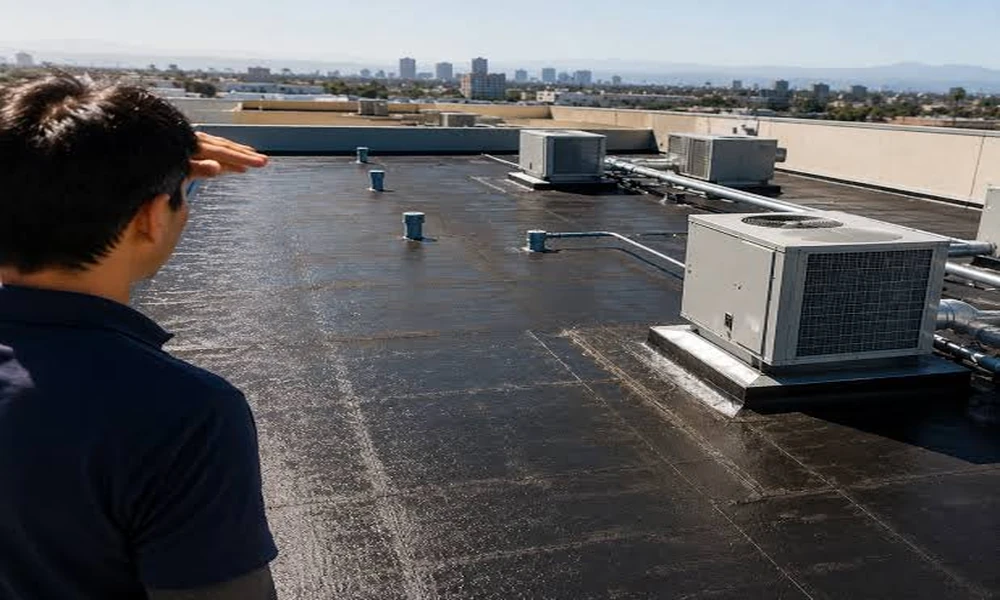
A roof can look completely ordinary from the street while making a house harder to cool every afternoon. In Rancho Cucamonga and across the Inland Empire, long stretches of intense sun expose differences in roof construction that may go unnoticed during cooler months. A contractor such as GAX Roofing works with shingle roofs, tile replacement, tile lift-and-relay, and flat roofing, which makes one distinction particularly useful for homeowners. The visible material, the waterproofing underneath, and the movement of heat through the attic are separate problems. Solving one does not automatically solve the others.
The afternoon test most homeowners never think to make
Imagine two neighboring houses with similar floor plans. Both have air conditioning, and both look properly roofed. Yet one upstairs bedroom stays uncomfortable until well after sunset. The difference might be attic insulation, blocked soffit vents, ductwork running through a hot attic, or the amount of sunlight absorbed by the roof surface. It might be several of those things together.
That is why a roof discussion should begin with symptoms, not a color chart. Note when rooms become uncomfortable, whether the ceiling feels unusually warm, and whether the problem worsens during consecutive hot days. These observations do not diagnose a roof, but they help distinguish a daytime heat issue from a leak or a general cooling-system problem.
A reflective surface is helpful, but it has a limited job
Cool-roof products are engineered to reflect more sunlight and release absorbed heat. These are measurable properties, not simply advertising names. The Cool Roof Rating Council explains the difference through its homeowner resources on roof ratings. Solar reflectance concerns how much incoming solar energy is reflected; thermal emittance describes how effectively a surface sheds absorbed heat.
A pale roof is not necessarily equivalent to a properly rated reflective roof, and two similarly colored products can perform differently. Product ratings, roof slope, local requirements, and how the entire assembly is installed matter more than appearance alone. Reflective shingles can be especially relevant when a full shingle replacement is already planned. Replacing otherwise sound roofing solely to pursue a possible cooling benefit, however, deserves a careful cost comparison.
Where the trapped heat goes
A roof can absorb less sunlight and still sit above an attic that gets extremely hot. Heat moves through the roofing assembly and into the space below, while poor insulation allows more of it to reach living rooms. Ventilation may help remove heat and moisture when properly designed, but a larger vent opening is not automatically better. Intake and exhaust must work together, and ventilation should not pull conditioned indoor air into the attic.
Before choosing a roofing product, ask someone qualified to check three things together.
Whether soffit intake pathways are blocked by insulation or previous work.
Whether exhaust vents suit the attic layout and existing intake area.
Whether insulation coverage and air sealing at the attic floor are adequate.
These checks can expose an inexpensive building-envelope problem that a premium roof covering would not fix. Homes with vaulted ceilings or unusual roof geometry may require a different approach because they lack a conventional open attic.
Tile introduces a different kind of hidden weakness
Across Southern California, concrete and clay tile often remain attractive long after the underlayment beneath them has aged. Tile sheds rain and shields the assembly from sunlight, but the underlying waterproof layer provides a critical second line of defense. Cracked flashing, failed penetrations, or deteriorating underlayment can allow water to reach the deck even when most tiles look intact.
This creates an important difference between a tile roof that needs new material and one that needs its waterproofing renewed. In a lift-and-relay project, usable tiles are carefully removed and later reset over new underlayment. A full tile replacement is more appropriate when tiles are extensively broken, unsuitable for reuse, or when an entirely new covering is desired. Neither choice should be made just because the roof has reached a certain birthday.
The places where hot weather and leaks meet
The most vulnerable roof areas are often transitions. Pipe penetrations, skylights, chimneys, valleys, patio connections, and the edge where a low-slope section meets a steeper roof each interrupt the ordinary flow of water. Sealants can dry out, fasteners can loosen, and flashing details can become exposed. Wind-driven rain then finds openings that were invisible during months without storms.
On a low-slope patio roof, drainage is particularly important because water moves away more slowly. A coating may reduce heat absorption on an eligible roof, but it cannot rescue wet insulation, rotted decking, failing seams, or a roof with unresolved ponding. Those conditions must be diagnosed before any coating proposal is accepted.
The evidence worth asking for before work begins
A roofing estimate should make the unseen portions of the job easier to understand. Photographs of damaged decking or failed underlayment provide more useful evidence than a distant picture of the roofline. An itemized scope should identify the material being removed, the waterproofing product being installed, and the treatment planned for penetrations and roof edges.
For homeowners comparing bids, the following details deserve attention before price.
Will the crew remove existing shingles down to the deck, or is an overlay proposed?
For tile, is the scope a repair, a lift-and-relay, or replacement with new tile?
What happens if hidden wood damage is found after tear-off, and how is extra work approved?
Who handles permitting, inspections, cleanup, and any solar panel detach-and-reset coordination?
This information makes estimates comparable. One bid may be cheaper because it omits a necessary detail rather than because the contractor found a better way to perform the same job.
Planning around the seasons, not just a leak
The best time to inspect vulnerable roof areas is before the first significant storm, not during one. In the Inland Empire, prolonged heat, dry conditions, Santa Ana winds, and seasonal rain create different stresses. Wind can lift already-weakened shingle edges or move tiles; rain later reveals the consequences. Hillside locations may also bring heightened fire considerations, making the rating of the complete roof assembly important.
A practical annual review starts on the ground. Look for displaced tiles, missing shingles, loose gutter sections, and debris collecting where roof surfaces meet. Inspect interior ceilings after rain for new stains. Avoid walking on tile or climbing a steep roof without proper equipment, since both the person and the roofing can be damaged.
A better decision begins with separating the problems
A hot room does not prove that a roof needs replacement. A broken tile does not necessarily mean the entire tile covering is exhausted. And a clean-looking roof does not guarantee that its underlayment or flashing remains sound. The strongest plan identifies whether the main issue is heat absorption, attic conditions, localized water entry, or broad deterioration of the roofing system.
Once those questions are answered, the options become clearer. Sometimes the right move is targeted flashing repair or attic work. Sometimes it is renewing the waterproofing beneath reusable tile. And sometimes a complete replacement is justified, with reflective materials considered as one part of a more durable roof assembly. The useful goal is not simply a cooler-looking roof. It is a home whose roof, attic, and waterproofing all do their own jobs reliably.

Comments are closed.